

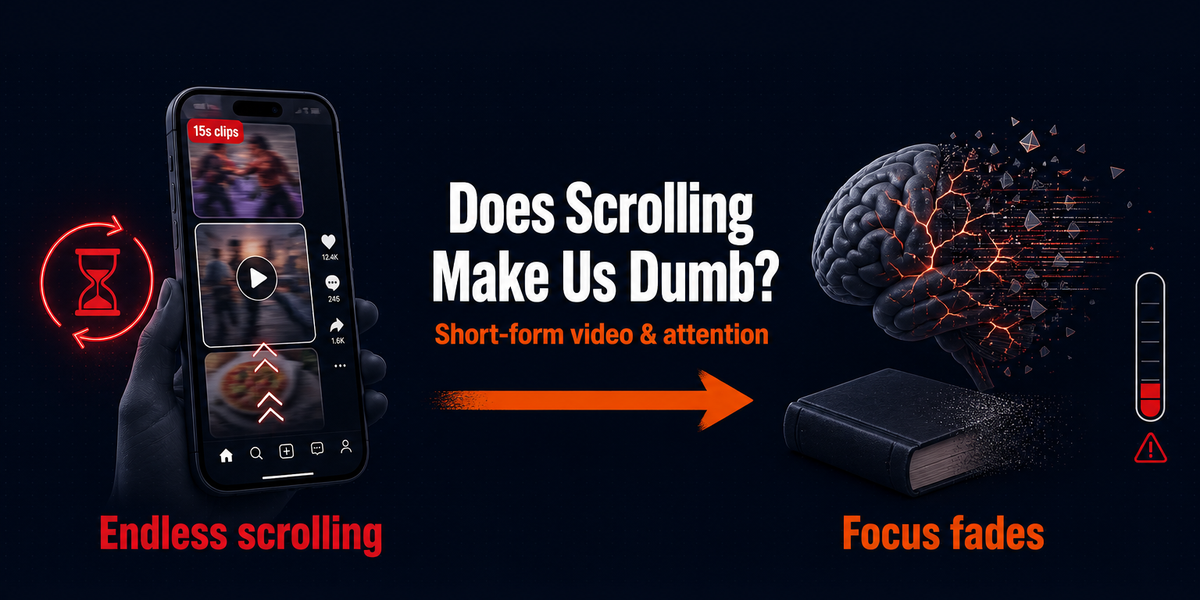
Series — Stay Away From Short Video (1 of 3).
Introduction
Open any phone on a commute, in a queue, or before sleep, and you will likely see the same motion: a thumb flicking through clip after clip. Short-form scroll videos—brief vertical videos in an endless feed—now appear across many apps. Names differ by platform; the behavior is the same: seconds of content, then the next one, with almost no stopping point.
A common worry follows: Does short-form video scrolling make people dumb? The question is blunt. Scientists rarely measure “dumb.” They measure attention, working memory, self-control, loneliness, anxiety, and compulsive use. When people say “dumb,” they usually mean something more precise: harder to focus on long tasks, weaker deep thinking, less patience for books or real conversations, and a mind trained to expect constant novelty.
This article walks through what research suggests so far—how short-form scroll video can fragment attention, how heavy feed use relates to isolation, how curated clips create an “imaginary world,” and where the science is still uncertain.
My position up front: I am not a fan of short-form scroll video, and I do not promote it. Platforms profit when you stay longer; your focus, sleep, and real relationships usually pay the bill. I will still be honest about what studies can and cannot prove—but I will not pretend this format is a harmless “just for fun” habit worth normalizing.
What “making people dumb” actually means
IQ scores are not collapsing overnight because of one video format. The stronger concern is cognitive style:
- Sustained attention — staying with one task without craving the next hit
- Executive control — planning, inhibiting impulses, switching tasks deliberately
- Deep processing — reading, learning, and thinking that need uninterrupted time
- Social cognition in real life — patience, empathy, and presence with people nearby
Short-form video can coexist with intelligence and still train habits that make complex work feel unusually hard. That is the useful framing: not “people become stupid,” but “brains adapt to the environment we feed them.”
How short-form scroll feeds are designed to hold you
These feeds are not neutral video players. Common design patterns include:
- Infinite scroll — no natural stopping point, so sessions extend without a decision
- Variable rewards — the next clip might be boring or brilliant; unpredictability keeps seeking behavior alive
- Algorithmic personalization — content is tuned to what keeps you watching longer
- High emotional intensity — humor, shock, beauty, anger, and FOMO packed into seconds
Researchers discussing addictive interface patterns note that infinite scroll removes friction that older “next page” designs provided, and that notification-and-reward loops can reinforce compulsive checking. See, for example, work on alternative feed designs and compulsive use: Defeat the feed (ACM, 2024).
On the brain side, reviews of social media algorithms describe how reward pathways (including dopamine-related reinforcement) can be repeatedly activated by likes, novelty, and personalized feeds—especially in adolescents whose impulse control is still developing: Social Media Algorithms and Teen Addiction (PMC).
Attention: the strongest everyday complaint
Many students and professionals report the same experience: after a long short-form scroll session, a book, lecture, or coding task feels slow and irritating. Research is starting to map that feeling.
What studies report
A CHI 2024 study combined a survey and a longer field experiment on short-form video and sustained attention. The survey found that more short-form video consumption related to poorer sustained attention. In the field experiment, simply changing duration did not cleanly improve every attention test—showing the relationship is real but not always a simple “watch less today, score better tomorrow” switch. Paper: Understanding the Effects of Short-Form Videos on Sustained Attention (ACM CHI EA 2024).
A systematic review of short-form video use among young adults (preprint) reported that high-frequency use was repeatedly linked with attentional disruption, reduced executive functioning, and emotional dysregulation, though many included studies were cross-sectional (snapshot, not long-term proof of cause). Review: The Impact of Short-Form Video Use on Cognitive and Mental Health Outcomes (medRxiv).
A youth-focused synthesis in European Child & Adolescent Psychiatry associated heavier, unstructured short-form video use with higher inattention and impulsivity and lower working-memory / self-regulation scores in available studies—again with the caveat that most evidence is still cross-sectional and needs stronger longitudinal designs: Taming the endless scroll? (Springer).
University cross-sectional work has also reported correlations between heavier short-form video use, reduced self-reported attention, and weaker academic outcomes: Short-Form Video Addiction, Attention Span, and Academic Performance.
A plain-language mechanism
Your brain learns from repetition. If most leisure minutes are spent switching context every few seconds, the internal “default” becomes novelty-seeking. Deep work—debugging, writing, studying—asks for the opposite: stable attention and delayed reward. Short-form scroll video is high-intensity training for the wrong mental sport: craving the next clip instead of finishing hard things. That is why I do not treat it as a neutral hobby.
A 2026 NeuroImage brain-imaging study goes further: when people watched preferred short videos to the end, key self-control regions (dACC and dlPFC) temporarily deactivated—a concrete neural clue for why immersive scrolling can feel hard to interrupt. Deep dive (Series Post 2): Why Preferred Short Videos Quiet Your Brain’s Self-Control Network. Original paper: Hong et al., NeuroImage (ScienceDirect).
A related 2025 NeuroImage study links higher short-video addiction symptoms with lower loss aversion and faster, more impulsive decisions—another reason the habit is a bad trade. Deep dive (Series Post 3): Short-Video Addiction and Loss Aversion. Original paper: Liu et al., NeuroImage (ScienceDirect).
Isolation: connected online, alone offline
Endless clip feeds create a feeling of social life—faces talking to “you,” comments flying, trends shared—while you may be physically alone for hours. That gap matters.
What research found about isolation and loneliness
A nationally representative U.S. study of young adults found that higher social media use (time and frequency) was associated with greater perceived social isolation—the opposite of the simple hope that more online contact automatically means more connection. Highest-use groups had substantially higher odds of greater isolation than lowest-use groups. Study: Social Media Use and Perceived Social Isolation Among Young Adults in the U.S. (Primack et al., PMC).
Later adult-focused work has continued to link higher amount/frequency of social media use with loneliness (correlation, not proven one-way causation). Summary coverage of one such study: Oregon State University overview.
Reviews of internet use and loneliness often return to two competing ideas:
- Stimulation hypothesis — online tools strengthen real relationships and can reduce loneliness
- Displacement hypothesis — time online replaces face-to-face time and can increase loneliness
Which path wins depends heavily on how people use the internet: to enhance real relationships, or to escape them. See discussion in the AMA Journal of Ethics: The Internet and Loneliness, and related SNS research: SNS use, social support, and loneliness (PMC).
How short-form scroll video can deepen isolation
- Time displacement — an hour of scrolling is an hour not spent on calls, walks, family, or hobbies with others
- Parasocial comfort — creators feel like friends, which can temporarily soothe loneliness without meeting the need for reciprocal relationships
- Social comparison spikes — seeing parties, bodies, income, and travel highlights can make real life feel smaller
- Passive consumption — watching strangers talk is not the same as being heard
You can be “social” for three hours and still end the night with nobody who knows your actual day. That is isolation wearing a social costume.
The imaginary world: curated reality and mental models
Feeds do not show life. They show an edited highlight reel optimized for retention.
What that does to the mind
- Distorted baselines — normal boredom, average bodies, slow careers, and ordinary homes look like failure next to polished clips
- Trend reality — what is viral starts to feel like what is true or important
- Identity by imitation — opinions, slang, humor, and even values can be absorbed from creators faster than from local community or careful reading
- Emotional whiplash — tragedy, comedy, ads, and self-help in one minute train shallow emotional switching
Primack and colleagues noted that curated peer presentations can foster envy and the belief that others live happier lives—one proposed pathway from heavy use to perceived isolation (same isolation study).
Short-form scroll video intensifies this because there is almost no context: a 20-second lifestyle clip has no unpaid rent scene, no boring Tuesday, no repair after a fight. The brain still updates its model of “how life looks.”
Imaginary world + weak attention = fragile judgment
When attention is trained for speed and reality is sampled from algorithms, critical thinking gets less practice. People may:
- Accept confident-sounding claims without checking sources
- Confuse familiarity (saw it 10 times) with truth
- Struggle to sit with uncertainty—the opposite of learning
That is closer to “mentally out of shape for hard thinking” than to a permanent drop in intelligence.
So… does short-form video scrolling make people dumb?
Honest answer: heavy, unstructured short-form scroll use is associated with worse attention control, more compulsive patterns, and—alongside broader social media use—higher loneliness/isolation for many people. That can look and feel like “getting dumber” in daily life: unfinished books, distracted study, shallow conversations, and a restless mind.
But science does not yet support a simple slogan like “short videos destroy IQ.” Much evidence is correlational. Lonely or stressed people may also scroll more. Study quality varies. That uncertainty is not a green light to keep the habit; it is a reason to be careful, not casual.
My summary:
- Short-form scroll feeds are engineered for prolonged engagement—against your long-term interests
- Overuse is linked with attention and self-regulation problems in multiple studies
- Heavy social media use is linked with feeling more isolated, not less, in key research
- Curated feeds can warp what “normal life” seems to be
- I do not recommend building a short-video habit; reducing or quitting is the better default
What I recommend instead of “managing” the feed
I will not sell you “healthy scrolling.” The product is designed to defeat moderation. If you still use these apps, treat reduction—or removal—as the goal:
- Delete or hide the apps — out of sight beats willpower after a long day
- If you keep one, lock it hard — OS screen limits, app blockers, grayscale; make opening it annoying
- No bedtime scroll—ever — protect sleep; tired brains feel “dumber” the next day
- Replace the slot — walk, call someone, read, lift, cook, write—something that leaves you with a result
- Attention workouts — daily deep-work blocks without the phone in reach
- Refuse the trend pressure — you do not owe any platform your spare attention
Conclusion
Short-form scroll video is brilliantly engineered to capture attention. That is not a compliment I want to celebrate—it is a warning. Used as a daily default, it can train a restless attention style, crowd out real-world connection, and pull people into a polished imaginary social world that leaves them oddly alone. Research on short-form video and social media use supports those risks more than it supports the casual claim that everyone is simply “getting dumb.”
I am not here to promote short video. I am here to say the format is a bad trade for most people who want a sharp mind and a real life. The smarter question is not only “Does short-form video scrolling make people dumb?” but “What kind of mind am I practicing every evening?” If the answer is endless novelty, stop practicing that. Your brain will adapt to a better environment too.
Quick checklist: name the real cost (attention, isolation, warped norms) → remember the feed is designed to keep you → read the research without sugarcoating → protect deep work and real relationships → reduce or quit short video; do not normalize it.
Series navigation: You are on Post 1 · Next: Post 2 — Self-control while watching · Then: Post 3 — Loss aversion
Research and further reading
- Hong et al., NeuroImage (2026) — Preferred short videos and cognitive-control deactivation
- Liu et al., NeuroImage (2025) — Loss aversion and short-video addiction
- CHI EA 2024 — Short-form videos and sustained attention
- Systematic review — Short-form video, cognition, and mental health (medRxiv)
- European Child & Adolescent Psychiatry — Endless scroll and youth neurocognitive outcomes
- Cross-sectional study — Short-form video, attention, and academics
- Primack et al. — Social media use and perceived social isolation
- SNS use, perceived support, and loneliness
- AMA Journal of Ethics — The Internet and Loneliness
- Social media algorithms, teen addiction, neurophysiological discussion
- ACM — Infinite scroll / feed design and compulsive use