Series — PHP php2shell Critical Bug (2 of 3). Read in order: 1) What the bug is → 2) Server & security impact (this post) → 3) How to prevent & patch.
Introduction
Part 1 covered what php2shell is. Part 2 answers the practical question owners care about: if my server is vulnerable, what can go wrong?
We will stay on impact and risk—not exploit recipes. The goal is to help you prioritize patching and monitoring for Laravel apps, CMS sites, APIs, and any internet-facing PHP.
The core security impact: remote code execution
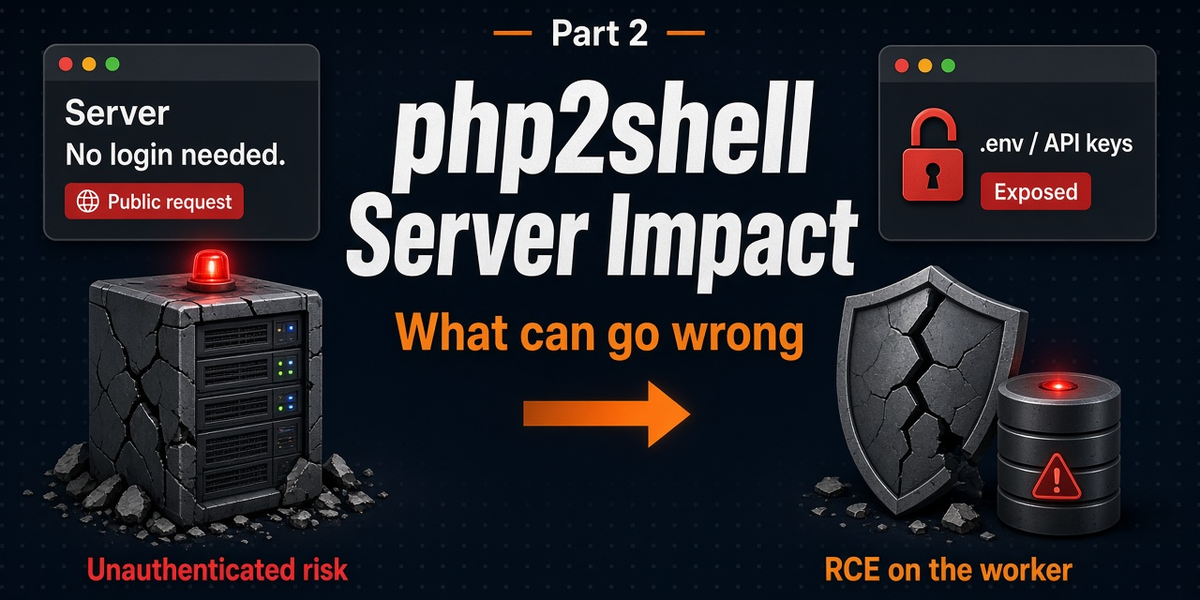
Both CVEs are treated as critical remote code execution (RCE) risks. In security terms, RCE means an attacker may get the server to run code they choose, in the context of the PHP / web process.
That is a different class of problem from a typical XSS popup or a missing CSRF token. RCE against the PHP worker is often a direct path to:
- Reading
.env, database credentials, API keys - Dropping a webshell or persistent backdoor
- Changing application files or uploads
- Pivoting to the database, object storage, or internal services the server can reach
- Using your server to attack other systems (spam, scanning, crypto-mining)
CISA’s guidance emphasized monitoring for suspicious activity such as PHP worker processes launching shells or downloading tools—classic post-compromise behavior patterns.
Why “unauthenticated” changes the threat model
Many bugs require a logged-in admin, a stolen session, or a specific plugin role. php2shell advisories describe unauthenticated risk: an attacker can try from the public internet without valid credentials.
That means:
- Your login form is not a gate for this class of bug
- Scanners can probe broadly and cheaply
- Internet-facing staging servers are as interesting as production
- “We only have a brochure site” still matters if PHP answers HTTP(S)
If the box is reachable and running vulnerable PHP, treat it as in play.
Why mod_php is called out as highest risk
Official materials note that on Apache with mod_php, a malicious request can hit the vulnerable path before application code executes.
Why that matters:
- Laravel middleware, WordPress security plugins, custom IP allowlists in app code may never run
- The vulnerability lives under the request lifecycle itself
- Default-ish setups were used in research demonstrations of full RCE
PHP-FPM and other SAPIs are still in scope. Advisories also discuss FPM susceptibility (including through application-level paths for some scenarios). Do not delay FPM patches because “we are not on mod_php.”
How this hits real project stacks
Laravel / custom PHP apps
Your framework version does not replace a PHP upgrade. Composer packages cannot fully paper over an engine-level memory bug. If production PHP is below the fixed patch level, the app inherits that risk.
Especially painful for:
- Admin panels and CRMs
- Client portals with invoices/files
- APIs that hold tokens and PII
- Multi-tenant SaaS on shared workers
CMS and bundled appliances
WordPress, Joomla, Drupal, and many appliances ship with or depend on host PHP. Vulnerability may hide inside a Docker image, a control-panel PHP selector, or a vendor appliance you did not build yourself. Inventory must include “products that contain PHP,” not only repos you deploy.
Shared hosting and agency client sites
Agencies often manage dozens of PHP sites. One delayed host upgrade can leave many clients exposed. Ask the host: which PHP builds are available, when were they patched, and are EOL versions still selectable?
Local XAMPP vs production
Local development boxes are lower priority than public servers, but do not confuse them. Production Apache/Nginx + PHP-FPM/mod_php is where scanners look first.
What a compromised PHP worker can mean for the server
Once code runs as the web user (often www-data, apache, nginx, or a pool user), impact depends on permissions—but even a limited web user is enough for serious damage:
- Confidentiality — steal env secrets, customer data, source, backups in web-readable paths
- Integrity — alter templates, inject malware into public assets, poison uploads
- Availability — crash workers, fill disks, ransom or wipe content
- Lateral movement — abuse DB credentials, cloud metadata, internal HTTP services
- Reputation — spam, phishing hosts, SEO spam pages on your domain
If the same OS user can write into the web root, persistence becomes easy. If secrets are world-readable in the project directory, credential theft is immediate.
Worker reuse makes stale-state bugs nastier
CVE-2026-109619 involves state that can survive incorrectly across requests on the same worker. Modern PHP deployments reuse workers for performance (FPM pools, mod_php processes). That reuse is normal and useful—until a bug lets one request leave landmines for the next.
Operational takeaway: crash loops, unexplained worker restarts, or weird intermittent fatals after disclosure are worth investigating, not ignoring.
What this does not automatically mean
- It does not prove every unpatched site is already owned
- It does not mean HTTPS alone stops it (TLS encrypts transport; this is server-side engine risk)
- It does not mean a WAF is a permanent fix (helpful temporary layer only)
- It does not mean only “big enterprises” are targets—automated scanning is indiscriminate
CISA noted it had not confirmed widespread in-the-wild exploitation at early publication time. That can change quickly once PoCs circulate. Patch urgency remains high either way.
Risk ranking for busy owners
- Internet-facing production PHP — patch today
- Staging / demos on public IPs — same day
- Admin-only VPN apps — still patch ASAP; reduce exposure meanwhile
- EOL PHP (8.1 and older) — upgrade plan is now a security incident, not a roadmap nice-to-have
- Containers / images / panel defaults — rebuild and redeploy; restart workers after upgrade
Conclusion
php2shell matters because it can turn a normal web request into a path toward unauthenticated remote code execution on the PHP process. From there, secrets, data, and trust are all on the table. mod_php is called out as especially dangerous; other SAPIs are not safe to ignore.
Understanding impact should create urgency. Fixing it is the next post: Part 3 — how to prevent and patch php2shell.
Series navigation: Previous: Part 1 · You are on Part 2 · Next: Part 3