

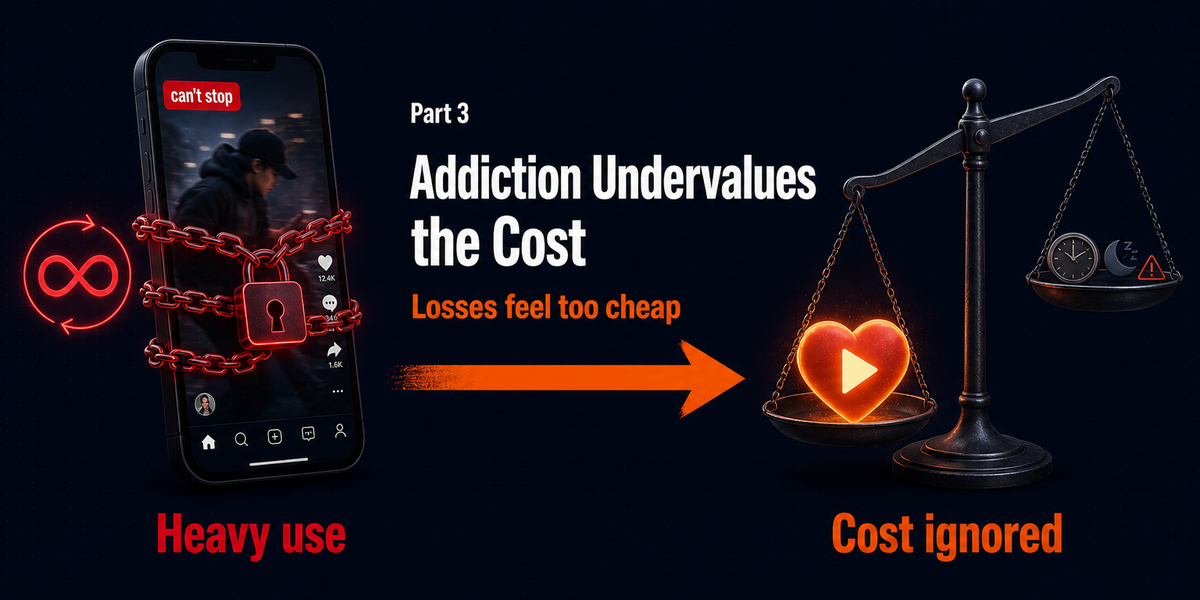
Series — Stay Away From Short Video (3 of 3). Start here if you missed the earlier posts: 1) Overview → 2) Self-control while watching → 3) Addiction symptoms and loss aversion (this post).
Introduction
Post 2 showed what can happen while a preferred short video holds you: key self-control regions go quieter. This post asks a different question about people who already show heavier, addiction-like short-video habits.
Are they less sensitive to losses—and more impulsive when deciding?
A 2025 NeuroImage study says the pattern points that way. Higher short-video addiction symptoms were linked with lower loss aversion (less deterred by potential losses) and faster evidence accumulation in decisions (quicker, more impulsive choices)—with matching brain-activity differences during a risk task.
My position: I am not a fan of short-form video, and I do not promote it. Instant-reward feeds do not only waste time in the moment; research like this suggests heavier use sits next to a decision style that undervalues cost. That is another reason to stay away—not to “optimize” the habit.
Read the original study here: Loss aversion and evidence accumulation in short-video addiction (ScienceDirect / NeuroImage).
Why this paper belongs in the series
Post 1 covered attention, isolation, and curated reality. Post 2 covered the brain during immersive viewing. This paper closes a practical loop:
- Post 2 — preferred clips can quiet control while you scroll
- Post 3 (this one) — addiction-like symptoms link to undervaluing losses and deciding faster
Together: hard to stop in the moment, and—among heavier users—a tilt toward underweighting what the habit costs. That is not a lifestyle I recommend.
What the researchers studied (in plain language)
The paper is titled Loss aversion and evidence accumulation in short-video addiction: A behavioral and neuroimaging investigation, by Chang Liu, Jinlian Wang, Hanbing Li, Qianyi Shangguan, Weipeng Jin, Wenwei Zhu, Pinchun Wang, Xuyi Chen, and Qiang Wang, published in NeuroImage (2025).
They recruited 36 university students (ages 18–24). Participants:
- Completed a scale of short-video addiction (SVA) symptoms (craving, loss of control, negative consequences)
- Did a mixed gambling task in an fMRI scanner—accept or reject bets with different combinations of possible gains and losses
- Had decisions modeled with the drift diffusion model (DDM), which estimates how fast evidence builds toward a choice, how much evidence is needed, and non-decision time
Loss aversion in plain terms: healthy decision-making often weighs losses more heavily than equal gains. That caution helps people avoid bad trades. Lower loss aversion means losses sting less—so risky options look more acceptable.
What they found
1. Higher addiction symptoms, lower loss aversion
People with higher SVA scores showed a significant negative link with the loss-aversion coefficient. In everyday language: more addiction-like short-video symptoms went with being less put off by potential losses and more open to risky bets in the task.
2. Faster, more impulsive evidence accumulation
The DDM drift rate helped explain that link. Higher SVA symptoms related to accumulating decision evidence faster—a signature of quicker, less deliberate choice. The authors connect this to underestimating long-term costs of endless swiping (time, sleep, health) while chasing instant pleasure.
3. Brain activity differed during gains and losses
- Gains: higher SVA symptoms linked with weaker right precuneus activity (a region tied to self-reflection, control-related processing, and value evaluation)
- Losses: higher SVA symptoms linked with stronger activity in the right cerebellum and left postcentral gyrus (motor/sensory-related areas)
- Precuneus activity during gains mediated links between SVA symptoms and both loss aversion and drift rate
4. Similar addiction profiles, similar brain patterns
Using inter-subject representational similarity analysis (IS-RSA), people with similar SVA symptom patterns also showed similar activation patterns in frontoparietal / cognitive-control networks and motor networks during gain and loss processing. Motor-network patterns helped mediate links between symptom similarity and decision parameters.
What this means if you still scroll
Read carefully—then take the warning seriously:
- Instant reward can train the wrong cost calculator — if losses feel smaller in the lab, the same tilt can make “just 20 more minutes” feel cheap in real life
- Impulsive evidence accumulation is not wisdom — faster deciding is great for viral feeds and bad for protecting sleep, study, and relationships
- This stacks with Post 2 — quieter control while watching + weaker loss sensitivity among heavier users = a habit designed to keep winning against you
I do not sell “mindful reels.” I say: treat short video as a product that competes with your judgment. Stay away when you can; shrink it hard when you cannot quit overnight.
Read this study fairly—without watering it down
I will not oversell the paper. I also will not let its borders become an excuse to keep the feed.
Do not claim more than the data shows
- Do not call it proof that short video caused the brain pattern — the design is correlational; people with certain decision styles may also scroll more
- Do not treat 36 students as every age group — young adults only; the warning still matters for anyone building the same habit
- Do not equate a lab gamble with a full life — hypothetical money risks are not identical to bedtime scrolling, but they probe loss/gain weighting
- Do not invent an IQ collapse claim — this study is about loss aversion and decision dynamics, not intelligence scores
Still: the useful warning stands
Even with those borders, the finding that matters for daily life is clear: higher short-video addiction symptoms went with lower loss aversion and faster, more impulsive decision processing, with related brain patterns. That is enough reason to refuse normalizing the habit—not to wait for a perfect lifelong experiment before you quit.
How to read the paper yourself
- Abstract — SVA symptoms, loss aversion, DDM, imaging summary
- Introduction — why loss aversion matters in addiction research
- Methods (lightly) — sample, addiction scale, gambling task, fMRI, DDM
- Results — behavioral link, mediation via drift rate, precuneus and related regions
- Discussion — undervaluing long-term costs of instant-reward use
Primary source:
https://www.sciencedirect.com/science/article/pii/S1053811925002538
Also citable as: Liu, C., Wang, J., Li, H., Shangguan, Q., Jin, W., Zhu, W., Wang, P., Chen, X., & Wang, Q. (2025). Loss aversion and evidence accumulation in short-video addiction: A behavioral and neuroimaging investigation. NeuroImage. DOI: 10.1016/j.neuroimage.2025.121250.
What I recommend
- Quit or delete short-video apps by default — do not negotiate with a product built for instant reward
- If you relapse, cut access first — blockers and removal beat “I’ll be careful”
- Protect the costs you undervalue — sleep, deep work, real conversations; schedule them so the feed cannot steal the slot
- Read Post 1 and Post 2 if you have not — attention/isolation overview, then the self-control viewing study
Conclusion
This NeuroImage study is a must-read next step after the viewing study: short-video addiction symptoms linked to lower loss aversion and faster impulsive decision-making, with related brain patterns during gain and loss processing. Instant-reward scrolling is not neutral entertainment. It sits next to a decision style that can make the costs of the habit feel smaller than they are.
I am not promoting short video. I am saying stay away. If you want the evidence first-hand:
Read the full study on ScienceDirect →
Series navigation: Previous: Post 1 — Overview · Previous: Post 2 — Self-control while watching · You are on Post 3
Research and further reading
- Liu et al. (2025) — Loss aversion and evidence accumulation in short-video addiction (NeuroImage / ScienceDirect)
- Same paper via DOI
- Series Post 2 — Preferred short videos and cognitive-control deactivation
- Series Post 1 — Does Short-Form Video Scrolling Make People Dumb?
- Hong et al. (2026) — Brain activity inhibition during Short Video Viewing